Most bank fraud stories start with a customer: a fake call, a link, an OTP shared by mistake. This one starts somewhere else, inside the pipes that connect banks to the apps and companies that move money through them.
In early November 2026, India's cyber agencies and the Reserve Bank of India raised the alarm about AI-assisted cyberattacks on these connections. Here is what has been reported, and why it matters.
What happened
According to a report by MediaNama, based on an exclusive by *The Head and Tale*, RBI met bankers for nearly two hours and issued a confidential advisory dated 3 November. Because the advisory is confidential, its details come from press reports and have not been published by RBI itself.
Around the same time:
- CERT-In, the national cyber security agency, issued an advisory on 4 November about a threat actor it named "CRAFTY FALCON". Attackers first sent Rs 1 transfers to test how money flowed, before trying larger amounts. They also got around IP allow-listing by routing traffic through shared third-party IP pools.
- I4C, the Indian Cyber Crime Coordination Centre under the Ministry of Home Affairs, issued a public advisory on AI-assisted attacks on banks, NBFCs and fintechs.
- CERT-In also released AI Security Auditing Guidelines.
One banker quoted in the report said individual frauds ranged from Rs 3 crore to Rs 15 crore, and that the sheer number of attempts worried banks even more.
Why APIs, and why AI
Banks today connect to many outside partners through APIs: NBFCs, payment aggregators, business correspondents, fintech apps. These connections let partners send payment instructions directly to the bank's systems.
That is convenient, and it is also a door. If an attacker gets into a partner's system, the bank may see instructions that look normal.
AI changes the speed. CERT-In Director General Dr Sanjay Bahl told MediaNama that "what would change is the speed, scale and level of automation at which cyber activities take place". He also warned that "AI agents are being trusted faster than they are being secured", and said defences have to become continuous, automated and work at machine speed.
What RBI has reportedly asked banks to do
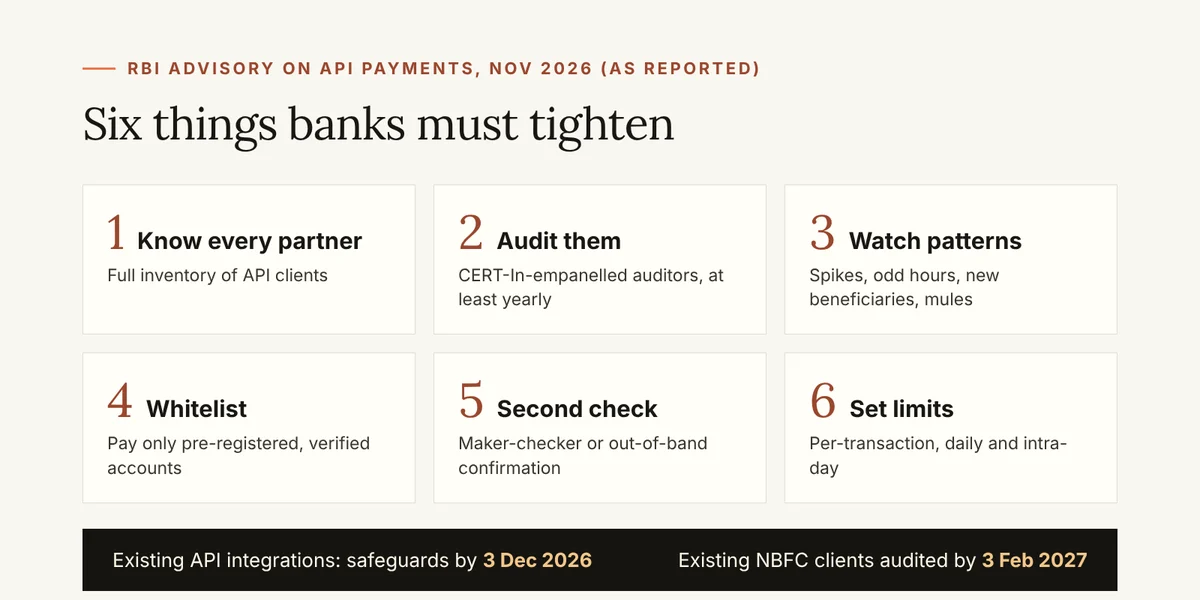
As reported, the advisory asks banks to tighten API payments on several fronts:
- Know every partner. Keep a full inventory of API clients: who they are, what they use, their limits and contacts.
- Audit them. NBFC clients need an audit by a CERT-In-empanelled auditor before onboarding. Existing ones have until 3 February 2027. Other partners such as BCs, payment aggregators and fintechs need risk checks now and audits within three months. Audits must repeat at least once a year, and after any serious incident.
- Watch the patterns. Bring API transactions under fraud monitoring, and flag spikes, amounts just below limits, odd-hour or holiday activity, bursts of new beneficiaries, mule patterns and failed logins.
- Whitelist beneficiaries. Payouts should go only to pre-registered, verified accounts. Changes to that list should need a separate channel with multi-factor authentication.
- Add a second check. Use maker-checker or out-of-band confirmation for API debit requests, at least above a risk-based threshold.
- Set limits. Put per-transaction and daily limits in place immediately, and intra-day or velocity limits within a month.
Existing integrations reportedly have until 3 December 2026 to put at least one such safeguard in place for API-based fund transfers. New integrations must comply before they go live.
The bigger picture
The same report lists other recent incidents. CoinDCX confirmed a loss of about Rs 152 crore. Central Bank of India alleged that hackers siphoned Rs 13.97 crore through its financial messaging system. SBI confirmed a suspected breach of 3,897 customer records.
The message from regulators is simple. Banks are responsible for what comes through their API connections, even when the weak link is a partner.
What this means for customers
These attacks target bank and partner systems, not your phone. But a few habits still help:
- Turn on SMS and email alerts for every transaction, and read them.
- Check your statement regularly for small, unfamiliar credits or debits, including Rs 1 test transactions.
- Report anything unusual to your bank right away. For cyber fraud, call 1930 or file a complaint at cybercrime.gov.in.
What this means if you work in a bank
The work of security is moving closer to everyday operations. Partner onboarding, limits, beneficiary changes and approvals all now have a security side. People who understand both the business and the controls, and who can spot a pattern that looks slightly wrong, will be in demand.
*Sources: MediaNama (6 November 2026), based on reporting by The Head and Tale; CERT-In and I4C advisories as reported. RBI's advisory is confidential and was not independently verified by MediaNama.*